

Employee experience has a direct impact on business performance. The way employees experience their work influences productivity, innovation, retention and customer outcomes.
Despite this, many organisations still approach employee experience, or EX, as a measurement exercise rather than a performance discipline. Surveys are collected, dashboards are built, but insight rarely translates into operational improvement.
This guide explores how to approach employee experience strategically, how to measure EX in commercial terms, and how to build a practical roadmap that connects employee insight to measurable business impact.
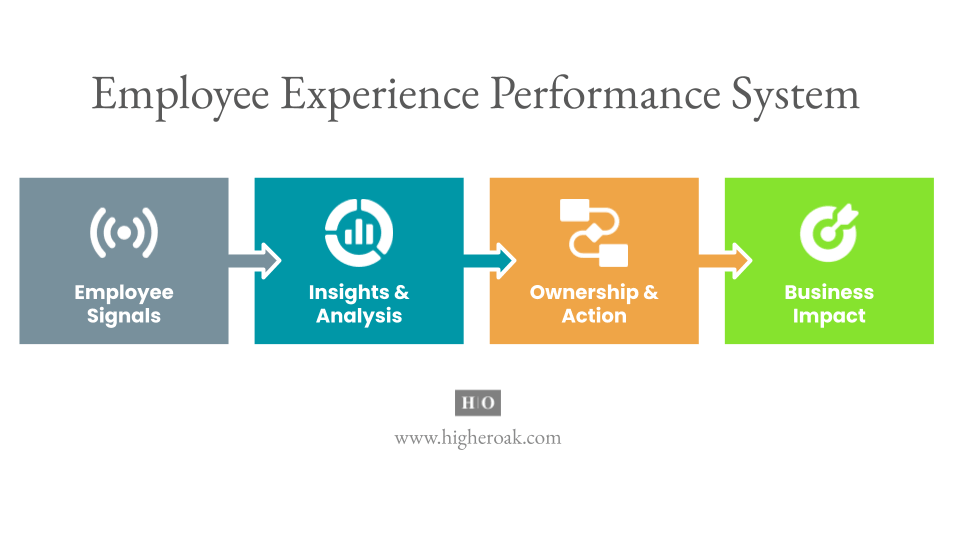
What Is an Employee Experience Strategy?
Employee experience encompasses every touchpoint across the employee lifecycle, from candidate experience to alumni relationships.
An employee experience strategy brings structure to that journey. It integrates people strategy, technology and culture to design, measure and continuously improve the moments that shape performance, engagement and retention.
Employee experience vs employee engagement
Engagement reflects how motivated and committed employees feel at a given moment. Employee experience is broader. It spans the entire lifecycle, from recruitment and onboarding through to development, transitions and exit.
Engagement is typically measured through periodic surveys. Experience combines lifecycle feedback with behavioural signals such as performance data, digital interactions and service tickets.
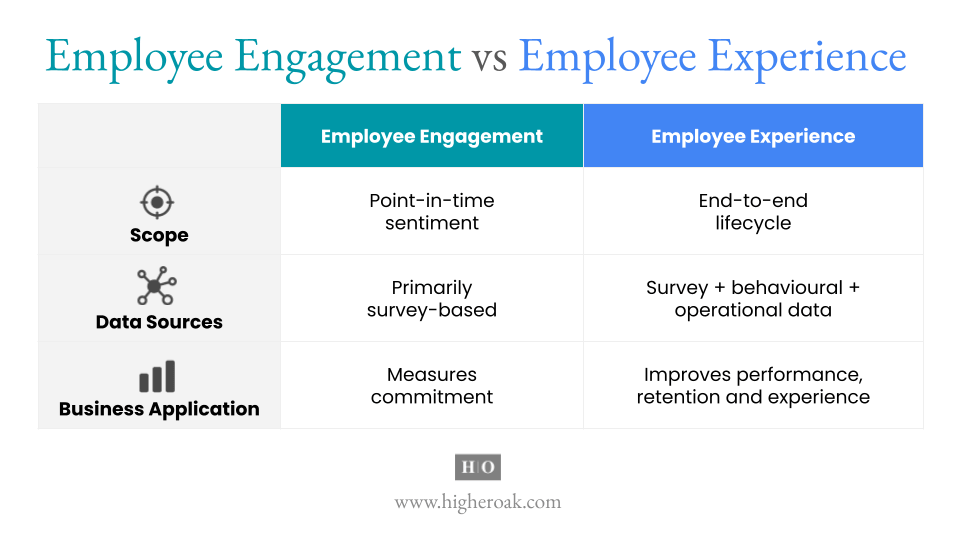
An effective EX strategy maps this full journey, identifies friction points and aligns improvements with business outcomes. Organisations that succeed treat EX as an enterprise priority, not an isolated HR programme.
Why Employee Experience Is Critical for Business Performance and Talent Retention
There is strong evidence that employee experience drives measurable business results. Gallup’s meta-analysis found that business units in the top quartile for engagement achieve 23 percent higher productivity and 18 percent higher profitability than those in the bottom quartile. Research from IBM’s Smarter Workforce Institute similarly links strong EX performance to significantly higher returns on sales and assets, while other studies associate high engagement with lower absenteeism.
Medallia case studies support the retention impact of EX. One Fortune 10 distributor used continuous listening to identify the true drivers of attrition, increasing productivity by 10 percent and achieving more than seven times annual return on investment. Another organisation improved employee Net Promoter Score by 15 points and halved turnover after introducing regular pulse feedback.
The risk of inaction is equally clear. Nearly half of workers report feeling burned out, and the World Health Organisation estimates that depression and anxiety cost the global economy around one trillion US dollars annually in lost productivity. Addressing workload, wellbeing and psychological safety is therefore both a human and financial imperative.
How to Measure the ROI of Employee Experience
Measuring the return on investment (ROI) of employee experience requires linking people metrics to business outcomes. Research shows that organisations reporting positive returns from EX investments tend to take a more structured and data-driven approach. They are significantly more likely to measure impact objectively rather than rely on anecdotal feedback, prioritise analytics and reporting capabilities within their EX platforms, and set clear goals tied to measurable outcomes. The research also indicates that companies tracking ROI consistently over time are far more likely to report positive financial returns than those taking an ad hoc approach.
EX ROI framework
An effective ROI framework combines leading indicators (predictive metrics) and lagging indicators (outcomes):
| Leading indicators (predictive) | Explanation and examples |
| Employee engagement and eNPS | Engagement scores and employee Net Promoter Score (eNPS) signal how employees feel about their organisation. Declines in intrinsic motivation can indicate productivity risks even when intent to stay remains high. |
| Likelihood to stay and attrition risk | Using people analytics, organisations can model which segments are at risk of leaving and why. For example, text analytics may reveal that not feeling valued predicts turnover more strongly than traditional engagement metrics. |
| Burnout and wellbeing indicators | Measuring workload, stress and psychological safety helps identify teams at risk. |
| Voice of the employee metrics | Response rates, sentiment analysis and frequency of feedback tend to correlate with whether employees feel heard. |
| Learning and development participation | Tracking uptake of training, internal mobility and goal completion rates tracks whether the organisation provides sufficient growth opportunities. |
Lagging indicators link employee experience to business outcomes:
- Productivity and performance – improvements in revenue per employee, output quality or customer ratings.
- Employee retention and turnover costs – reductions in voluntary turnover or time‑to‑fill vacancies. One Medallia case study showed that monthly micro pulses led to a 50 % reduction in turnover.
- Customer satisfaction and loyalty – correlations between employee experience and Net Promoter Scores, service quality and customer retention. Research has found that every one‑star increase in an employer’s Glassdoor rating improves customer satisfaction by 1.3 points.
- Financial results – linking EX improvements to sales growth, revenue per employee and profitability. IBM’s research found that delivering top‑tier employee experiences correlates with 31 % higher revenue growth.
ROI calculation should link reduced attrition and absenteeism with measurable productivity and revenue gains, weighed against total EX investment. Leading platforms consolidate feedback, behavioural and operational data into integrated dashboards, allowing executives to quantify impact and focus resources where returns are strongest.
Example: Calculating the financial impact of improved retention
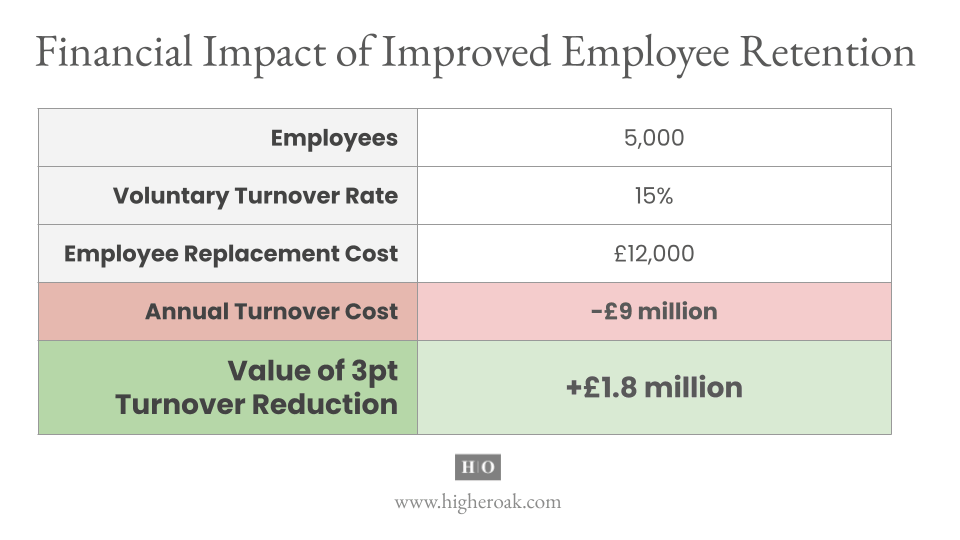
If the average cost of replacing an employee (recruitment, onboarding and lost productivity) is £12,000, annual turnover costs the organisation roughly £9 million.
Reducing attrition by just three percentage points would retain 150 additional employees, avoiding approximately £1.8 million in annual replacement costs. Even modest improvements in employee experience can therefore generate substantial financial returns.
Core Employee Experience KPIs and Metrics That Matter
Selecting the right metrics ensures that employee experience initiatives are data‑driven and aligned with strategy. Key measures include:
- Employee engagement scores – measure commitment, pride and motivation. Falling engagement or intrinsic motivation may signal productivity risks.
- Employee Net Promoter Score (eNPS) – calculated by subtracting the percentage of detractors from promoters. eNPS provides a simple indicator of advocacy and is predictive of retention and morale.
- Likelihood to stay – often measured via survey questions or predictive models that estimate attrition risk. Consider segmenting results by tenure, role and manager to identify hotspots.
- Burnout risk indicators – track workload, stress and wellbeing. High burnout undermines engagement and productivity.
- Performance and customer outcomes – Business units in the top quartile for employee engagement achieve significantly higher customer loyalty and satisfaction scores than those in the bottom quartile. The findings indicate a clear link between stronger employee experience and improved customer outcomes.
- Turnover and absenteeism rates – among the most direct and quantifiable links between employee experience and financial performance, because they translate immediately into recruitment costs, lost productivity and operational disruption.
- Internal mobility and development metrics – lack of career growth opportunities is a well-established predictor of turnover, whereas clear pathways for promotions, lateral moves and learning completion boost retention.
The Employee Experience Roadmap: A Three‑Phase Strategy Framework
An EX roadmap helps organisations move from ad‑hoc initiatives to sustained, scalable programmes. Effective programmes follow a cycle: capturing signals from employees, translating them into actionable insight, assigning ownership for improvement and tracking measurable business impact.
Phase 1 – Aligning Employee Experience Strategy with Business Goals and Analytics
- Secure leadership sponsorship and define objectives. EX requires cross‑functional ownership; HR teams alone control only a fraction of the touchpoints that shape experience. Set clear goals tied to business outcomes such as productivity, retention and customer satisfaction.
- Map the employee lifecycle. Visualise each stage of the employee journey – recruitment, onboarding, engagement, development, progress and off‑boarding – to identify pain points and “moments that matter”. This mapping helps prioritise interventions and ensures that no cohort is overlooked.
- Collect baseline data. Use existing survey data, exit interviews and HRIS data to understand current sentiment and behaviours. Combine these with operational metrics (e.g., performance, customer ratings) to build a holistic view.
- Build a data‑driven EX strategy. Determine which metrics will be leading indicators versus lagging outcomes. Apply analytics to identify drivers of engagement, retention and performance. Align the strategy with business priorities (growth, innovation, cost control) and set targets
Phase 2 – Building a Continuous Listening and Voice of the Employee (VoE) Strategy
Continuous listening means gathering feedback and behavioural signals across the employee lifecycle and acting on them in near‑real time. Best practices include:
- Use multiple listening channels. Relying solely on annual or always‑on pulse surveys can miss critical context. Adopt a blend of organisation‑wide surveys, short pulse surveys, lifecycle touchpoint surveys (e.g., after onboarding, promotions or exits) and 360 feedback to capture varied perspectives.
- Capture signals beyond surveys. Broaden understanding by analysing signals such as chat transcripts, performance reviews, PTO patterns and helpdesk tickets. AI and analytics can integrate these unstructured data sources to proactively evaluate key business drivers like turnover risk.
- Optimise listening at moments that matter. Feedback collected at key events – pre‑hire, onboarding, promotions, transitions and exits – has an outsized impact on engagement, productivity and retention. Try to be economical with surveys and ask the right questions at the right time.
- Ensure psychological safety and trust. Employees are more willing to share honest feedback when they feel safe. Psychological safety is created when leaders frame work as a learning opportunity, invite participation and respond appreciatively. Transparent communication about how data will be used also builds trust.
- Democratise listening. Empower “EX champions” or managers to host open discussions to explore feedback collaboratively. Research has found that 74 % of employees feel more effective when they’re heard, yet most feel their voices aren’t heard fairly.
Phase 3 – Turning Employee Experience Data into Action and Ownership
- Create an action planning framework. After analysing feedback, establish processes for leaders to develop action plans. Best‑practice programmes use integrated closed‑loop feedback loops to show employees that their input leads to improvements.
- Assign ownership and accountability. Define who is responsible for implementing actions at different levels (executive, departmental and team). Leaders must model the desired behaviours, allocate resources and track progress. Lack of executive sponsorship is a common omission that severely undermines EX strategies.
- Integrate EX governance. Establish regular review cycles, key metrics and decision‑making forums. Link EX results to performance reviews and leadership KPIs. Organisations with EX on executive scorecards are more likely to realise ROI.
- Communicate progress and celebrate wins. Closing the loop includes updating employees on actions taken and celebrating improvements. Transparency sustains engagement and trust.
Continuous Listening Strategy: Best Practices for Capturing the Voice of the Employee
Continuous listening is about disciplined execution, not simply increasing survey frequency. To make it effective:
- Use a balanced signal mix. Combine lifecycle surveys with behavioural and operational data so insight is not dependent on self-reported sentiment alone. Analysing patterns in performance data, service tickets or collaboration tools can surface early warning signs that surveys may miss.
- Focus on high-impact moments. Prioritise onboarding, role changes, promotions and exits, where experience most strongly influences retention and performance. Concentrating effort at these inflection points produces clearer insight and more measurable outcomes.
- Minimise friction. Keep feedback targeted and concise, and supplement surveys with passive signals to avoid fatigue. Employees are more likely to engage when they see that input is purposeful rather than routine.
- Close the loop quickly. Insight only creates value when acted upon. Equip leaders with clear priorities, simple action frameworks and defined ownership so feedback translates into visible change.
- Connect insight to context. Integrate EX data with HR and operational systems to understand drivers, not just scores. Linking experience data to performance, attrition or customer outcomes allows organisations to prioritise interventions based on impact.
Embedding Employee Experience into Leadership and Organisational Culture
Employee experience is not an HR silo. It becomes sustainable when leaders at all levels champion it and when it is embedded into organisational culture.
- Develop EX leadership capability. Managers shape at least 70 % of variance in engagement, so investing in their development is essential. Train leaders to coach, give recognition, set clear expectations and create psychological safety.
- Promote psychological safety. Research by Harvard Business School suggests that psychological safety – the belief that one can speak up without risk – enables innovation and learning. Leaders can foster this climate by framing work as learning, inviting participation and responding appreciatively to questions and challenges.
- Cultivate a culture of trust and benevolence. Fewer than half of employees say they trust organisational leaders to do what is right, highlighting a persistent gap between leadership intent and employee confidence. The findings suggest that building trust requires consistent, transparent decision-making and visible commitment to employee wellbeing, not just strong business performance.
- Align rewards and recognition with values. Employees who receive meaningful, well-aligned recognition are significantly more engaged and less likely to leave their organisation. Recognition programmes that reinforce organisational values and celebrate the behaviours that define the desired culture therefore play a direct role in strengthening engagement and retention.
How to Choose the Right Employee Experience Platform
The proliferation of EX platforms makes evaluation challenging. However, technology alone rarely determines success. Governance, leadership ownership and operational readiness usually have a greater impact on whether employee insight actually translates into measurable improvement.
Focus on solutions that are scalable, secure and align with your organisational needs. Best in class platforms combine multi‑channel listening, AI‑powered analytics and action management to drive continuous performance improvement. When assessing platforms, consider the following.
Evaluating Employee Experience Software Based on Stakeholder Needs
- HR teams require flexible survey design, segmentation, dashboards and integration with core HR systems. They need tools to identify trends, predict turnover and design interventions.
- C‑suite and boards seek high‑level analytics linking EX to strategic outcomes such as revenue, productivity and customer satisfaction. Executive scorecards should include EX goals to ensure accountability.
- Managers need intuitive interfaces, targeted recommendations and the ability to see team‑level results without violating confidentiality. Embedding feedback and recognition into collaboration tools helps managers act in the flow of work.
- Employees value ease of use, mobile access and assurance that their feedback is confidential. Platforms that provide transparent communication, quick response to issues and self‑service support build trust.
Key Features to Look for in an Employee Experience Platform
- Customisable dashboards and advanced analytics. Dashboards should provide real-time visibility into engagement, sentiment and performance, allowing stakeholders to drill into segments, compare against benchmarks and track trends over time. Built-in people analytics and text analytics tools should enable rapid root-cause analysis, not just surface-level reporting. The platform should make it easy to connect employee data with operational and customer metrics in one environment.
When this capability is limited, organisations often end up exporting data into spreadsheets or BI tools to do meaningful analysis. Insight becomes fragmented, slower to generate and harder to trust. Leaders may see scores, but struggle to understand what is actually driving them or how employee experience connects to business outcomes.
- Lifecycle automation. Platforms should automate the collection of insight at key moments such as onboarding, role transitions, parental leave, internal mobility and off-boarding. These journeys should trigger personalised communications, nudges and actions based on responses, so the programme moves from listening to doing.
Without strong lifecycle automation, programmes default to periodic surveys only. Important moments pass without feedback, and organisations miss early warning signs of disengagement or attrition risk. HR teams are then left reacting to problems rather than preventing them.
- Integrated feedback and performance tracking. A robust employee experience platform should unify surveys, pulse polls, 360 feedback and performance data into a single, coherent view. This enables organisations to understand how engagement, enablement, recognition and leadership behaviours interact. It should also support advanced text analytics to extract themes from open comments at scale.
When these elements sit in separate tools or disconnected survey programmes, it becomes difficult to analyse patterns across datasets. Teams may run multiple surveys that feel repetitive to employees, yet still lack a holistic understanding of experience drivers. The result is survey fatigue without strategic clarity.
- Enterprise-grade integrations with HR and collaboration systems. Seamless integration with collaboration tools such as Slack and Microsoft Teams, HRIS platforms, IT service management systems and learning platforms reduces friction and allows data to flow smoothly. Bi-directional integrations are particularly important, enabling actions to be triggered automatically in other systems rather than relying on manual follow-up.
If integrations are limited, one-directional or heavily customised, organisations can face higher maintenance costs and slower time to value. Action management becomes manual, increasing the risk that feedback is acknowledged but not addressed. Over time, this can erode trust in the programme.
- Confidentiality, governance and enterprise controls. Employees must trust that their data is protected. Look for robust anonymity thresholds, role-based access controls, consent management and compliance with privacy regulations such as GDPR. Enterprise-ready platforms should provide transparent explanations of how data will be used and clear governance over who can view which insights.
- When governance controls are weak or overly simplistic, leaders may either see too much or too little. Overexposure of small team data can undermine trust, while overly restrictive reporting can limit accountability. In both cases, the credibility of the programme can suffer.
Beyond the Platform: Governance, Partnership and Long-Term Impact
Technology is essential, but it is only one part of a successful EX programme. One of the biggest pitfalls isn’t just buying the wrong platform, it is failing to embed it properly in the organisation. When you evaluate vendors, look for a partner who can guide governance, adoption and long-term value, not just provide and configure software.
- ROI-led programme design. Your vendor should start with business goals, not survey templates. Discovery sessions, journey mapping and stakeholder input should shape a programme that links feedback to retention, revenue or efficiency. Configuration should support clear outcomes from the outset.
- Proven implementation and integration expertise. Look for a track record of successful implementations in organisations similar to yours. Integration with CRM, contact centre, HR or operational systems should be a core strength, not an afterthought. Clean data flows, clear ownership and tested integration processes reduce risk and increase confidence from the outset.
- Operational readiness at launch. A successful launch requires the business to be ready, not just the technology platform. Role-based training, clear workflows and defined escalation paths ensure teams know how to act on insight from day one. Readiness should be validated through testing and sign-off so that people, process and technology move in step.
- Adoption and enablement. Dashboards alone do not change behaviour. Communication plans, leadership engagement and internal champions help embed feedback into everyday decisions. Adoption should be tracked through usage metrics and workflow activity so you can see whether insight is truly being used.
- Governance and change control. Once live, the programme will evolve. Working groups, steering oversight and a formal change process help prioritise enhancements and keep the focus on business value. Clear governance prevents scope drift and ensures improvements remain aligned to strategy.
- Ongoing optimisation and expansion. EX programmes should not stand still. Regular reviews help identify new use cases, additional touchpoints or deeper analysis that can drive further value. A flexible support model allows internal teams to lead while drawing on specialist expertise for complex projects or strategic input.
- SLAs and responsive support. Defined service levels, proactive monitoring and clear response times protect trust in the system. Quick resolution of issues keeps engagement high. Strong support combines technical reliability with practical guidance.
- Robust Data governance and security. Role-based access controls, clear data handling rules and compliance standards must underpin the entire lifecycle. Good governance protects integrity while enabling insight to reach the right people. Trust in the data is fundamental to trust in the programme itself.
Common Mistakes to Avoid When Building an Employee Experience Strategy
- Treating EX as an HR‑only initiative. Experience touches every facet of the organisation. Without cross‑functional buy‑in and executive sponsorship, EX efforts stall.
- Survey fatigue and poor listening. Bombarding employees with surveys or asking irrelevant questions reduces participation and trust. Focus on targeted, thoughtful listening and act on the results.
- Failing to act on data. Collecting feedback without closing the loop breeds cynicism. Create mechanisms for action planning and communicate progress.
- Not digging into the “why.” Surface metrics rarely explain underlying issues. Use text analytics, interviews and focus groups to explore root causes.
- Lack of psychological safety. Without a culture that encourages speaking up, feedback may be distorted or withheld.
- Ignoring manager development. Managers account for a large share of engagement variance. Under‑investing in their skills undermines EX efforts and contributes to burnout.
- Treating technology as a silver bullet. AI and analytics support listening and action, but human judgement, empathy and trust remain indispensable.
Frequently Asked Questions About Employee Experience Strategy
- What is an employee experience strategy? A strategic plan to design, measure and enhance every aspect of the employee lifecycle – from recruitment to off‑boarding – to improve engagement, performance and retention.
- How is employee experience different from engagement? Engagement measures emotional commitment at a point in time, while experience encompasses the entire journey and the underlying moments that influence how employees feel.
- How do you measure employee experience ROI? Combine leading indicators (engagement, eNPS, burnout risk, likelihood to stay) with lagging indicators (productivity, turnover, customer satisfaction and financial results). Use analytics to link improvements in EX to business outcomes.
- What is continuous listening in HR? An ongoing process of gathering feedback and behavioural signals across multiple channels and moments, enabling organisations to understand employee sentiment and act in real time. It includes surveys, pulse checks, lifecycle surveys, 360 feedback and analysis of unstructured data.
- What does an employee experience platform do? It centralises feedback collection, analytics and action planning. Key capabilities include survey and pulse tools, AI‑powered sentiment analysis, dashboards, lifecycle automation, integrations with HR and collaboration systems, confidentiality controls and action management.
Conclusion: Building a Data‑Driven Employee Experience Strategy for Sustainable Growth
Employee experience is no longer a soft concept; it is a measurable driver of productivity, profitability and resilience. Organisations that take a systematic, data‑driven approach – aligning EX with business strategy, listening continuously, acting on insights and embedding EX into leadership and culture – realise tangible benefits. Evidence shows that high‑engagement organisations deliver higher revenue growth, lower turnover and reduced burnout. Conversely, neglecting EX exposes organisations to hidden costs such as disengagement, burnout and reputational damage.
Modern EX platforms such as Medallia provide the technology and analytics to operationalise continuous listening and translate insights into action. Yet technology alone is insufficient; success depends on leadership commitment, psychological safety and a culture that views employee feedback as a catalyst for learning. By making EX a core part of organisational strategy, businesses can build sustainable growth and create workplaces where people thrive. Organisations that succeed treat employee experience not simply as a listening programme but as a disciplined system for improving performance, culture and operational outcomes.